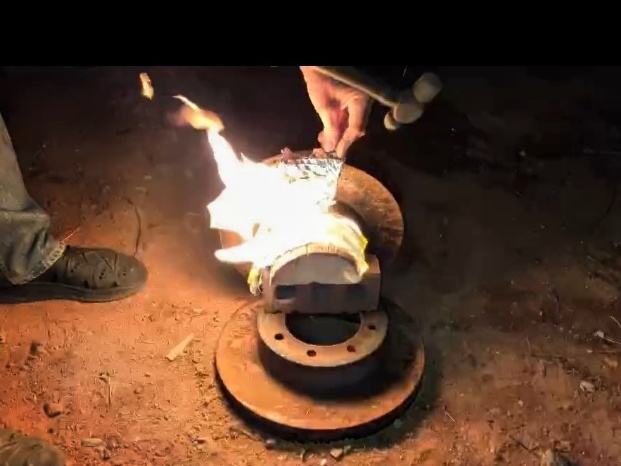
 Over the years I’ve viewed science teacher videos on the web that demonstrate the effects of a thermite reaction when two rusty ball bearings were used with one being covered with aluminum foil were struck together to create a massive spark. It was very impressive and of course where there are sparks, there is the possibility to use them as an ignition source.
I was unable to acquire the large ball bearings needed to accomplish this feat and so resigned it to my bucket list. However recently I viewed a video that showed the use of a hammer, aluminum foil, a very rusty disc, and a treated cloth used as tinder to recieve the sparks.
In pursing this method I tried striking foil on top of various rusty items without success. I finally contacted my mechanic friend and asked him if he had any scrap brake rotors that were rusty and fortunately was able to acquired some.
At first I tried to strike the rusty flat disc surface with a ball peen hammer using the flat end but had almost no sparks. Then I used the ball peen end and had better results. Then it dawned on me that the teacher demos used 2 ball bearings for a reason that the curved surfaces provided a single point of contact for effective kinetic energy transfer so I chose to strike the “hat” portion of the rotor that had a curved surface and “presto”! Great sparks were achieved.
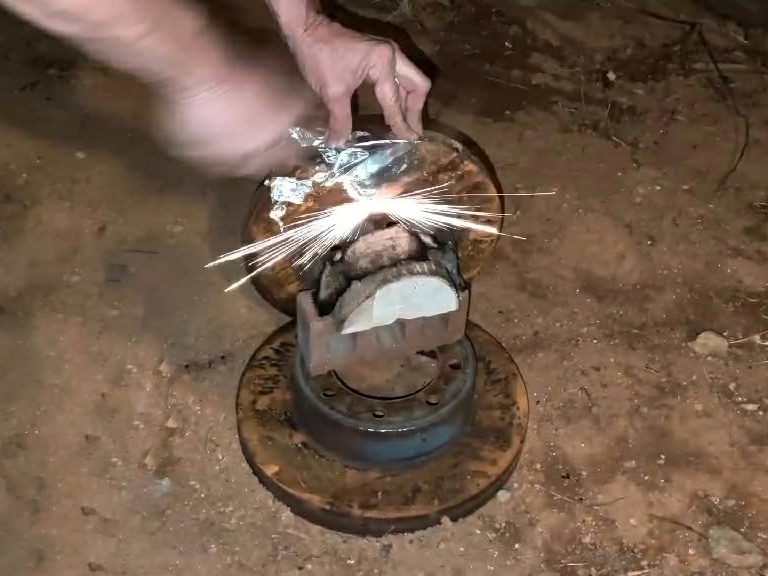 To capture the sparks I applied a spirit accelerant to a cloth and layed it next to the metal surface that I was striking. When attempting this it is important to exercise caution as the accelerant can be quite volatile so a pair of tongs can be useful to remove the ignited tinder to a safe place and enabling a way to smother it out for additional safety.
So now you know a another method to create a fire that would make MacGyver proud and might be needed in an emergency situation.