 I am fortunate to have a pond on my property that was created by the construction of a dam. It is interesting how what Man has created, Nature over takes. Trees had begun to grow on the outer wall which looks nice, but can have adverse effect. If the roots penetrate the wall, it could compromise it’s integrity and cause leaks to occur. It is necessary to keep the wall of a dam clear of this type of growth.
On several occasions I have cut down the saplings and young trees that had grown in girth and height and ended up piling them up in a heap that remained neglected. This year I am taking a different approach. Rather than cutting them down, I am girdling them in place that will stop their growth and prepare them for firewood harvest as needed.
What is girdling? It is the practice of cutting off at the base of the tree the outer bark and sub layer called the cambium layer that supplies the nutrients and moisture to the tree that gives it life. By employing this method a tree can be selected generally for future firewood so that it can “season” in place, thus avoiding being piled up or left on the ground to rot or be compromised by bugs.
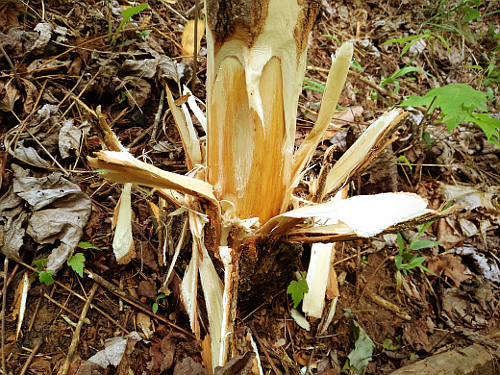
A selected tree can have the bark carefully removed by cutting two lines around the circumference several inches apart then the strip of bark in between wedged or pried off like a band. In my case, with so many small trees I used a Kukri knife to quickly cut strips away to separate the cambium layer off of the core as illustrated in the photo. In this manner I have arrested the growth of the trees on the wall and can harvest them at my leisure. At least this is my theory and I’ll be watching the results as the year passes.
So if you have land that is forested you can strategize your future crop of firewood or use this method to control emerging trees that grow in an inappropriate place.




I found your post on tree removal for survival scenarios incredibly informative! The way you broke down the process and tools needed was very practical, especially for those of us interested in self-reliance and outdoor skills. I was particularly interested in your advice on choosing the right saws for different tree sizes; it’s helpful to know when a handsaw is sufficient versus when an axe or other tool might be more effective.
I also appreciated the safety tips you included. Tree removal can be risky even in a controlled environment, so it’s great that you emphasize caution in a survival context where professional assistance may not be available. Given the variety of situations where tree removal might be necessary, do you have any recommendations for specific tree species that are easier (or harder) to process and use for shelter or firewood in the wild?