Ken on June 27th, 2009

About 2 weeks ago I wrote a blog (Technomania… has it gone too far? - 14 June 2009) that questioned technology and it’s reliability for survival. However, technology CAN be a tremendous asset… I just like to know how to survive without it. But let it be known that I DO carry a lighter… why not use the easiest method when it’s available.
Recently I had access to an iPod Touch and was delighted to discover some of the apps available for survival scenarios. Some apps are super simple, and some are very sophisticated. The following list is just a sampling of what’s available. You can use your favorite search engine to find these and many more online.

SOS Light - is a FREE tiny application that uses iPhone/iPod Touch as a SOS light. It allows you to blink SOS morse code light, alpine distress help, and alpine distress reply light while choosing different colors of light - white, red, green, blue, cyan, pink, and yellow.
Morse Code - Translates text into morse code and sends the message with a blinking iPhone. You can use the characters A..Z, numbers 0..9 and the special chars .,:;?
Celestial Compass v. 2.0 - Turns your iPhone or iPod Touch into a compass with the aid of the Sun, Moon, or Big Dipper.
LocationGPS v. 1.0 - Is a compass utility that calculates your bearing based on GPS coordinates.
Compass Flashlight v. 1.1 - Is a GPS compass AND a flashlight! It shows the major cardinal directions without the need for internet or cell reception when you are outdoors.

If you have used any of these apps or different ones, please share your comments.

Bookmark and Share

Tags: , , ,

Ken on June 21st, 2009

If you are new to Survivaltek, WELCOME! This survival blog is my attempt to share knowledge and experience in skills of survival, spanning wilderness to urban settings, or anywhere else you might be stranded. I welcome constructive comments and value guests who share their own knowledge and experience so that we may all be better prepared to survive.
You can view this site by selecting Posts, Pages or Tags - or - use the search function to find topics that you are interested in. If you can’t find what you’re looking for, please visit the Contact page and let me know… perhaps it will be the topic of one of the future blog posts.
To keep current on new Survialtek posts, you can subscribe to this site via RSS by clicking on the orange RSS button above. Additionally, you can subscribe to the Survivaltek Newsletter using the submission form to the right. The Survivaltek Newsletter contains announcements, more in-depth articles and special offers for Survivaltek subscribers.

Bookmark and Share

Tags: , , ,

Ken on June 14th, 2009

I’ve always maintained that there’s nothing like the right tool for the job! But with today’s crazes, some tools try to combine too much, and don’t necessarily do any one thing well. There is an age-old saying that “less is more” which can be applied in many areas, especially regarding reliability. Generally, the fewer the moving parts, the less chances for failure. Renaissance scientists defined the six classical simple machines as the lever, wheel and axle, pulley, inclined plane, wedge, and screw. Within modern machines are found these elements. So, when you choose a tool, especially for survival, think reliability, durability, and safety… your life may depend on it!

Bookmark and Share
Ken on June 6th, 2009

If you need a torch, one can be made using bamboo, fiber, and oil. I was recently asked to make a set of torches for a “crossing over” ceremony, where Cub Scouts who achieved the Webelo level, graduate and join a Boy Scout troop. Torches were traditionally used to carry the flame down to start the camp fire, initiating the ceremony. We had plenty of bamboo which we used earlier during wilderness survival classes so we had a wonderful resource for constructing a torch.

By using a length of bamboo, all that was needed was to create a small reservoir for lamp oil with a support structure which acted as a wind screen. I started by cutting about 6 inches above a bamboo segment node. At 3 inches, I made 3 small cuts evenly spaced around the circumference, then I used a knife to split the bamboo from the end down to the cross cuts, creating in effect 3 fingers at the end. I placed some cotton fiber into the bottom of the segment reservoir and left about an inch above the cut. I then poured lamp oil onto the wick, saturating it well. The wick was then lit and the torch could be carried where needed.

Unless a torch is made of metal, it will eventually be consumed unless it is extinguished. This torch is a visual delight and was quite practical for the event. Remember not to fill the reservoir too full, and lean the torch away from you and other flammable things.

Bookmark and Share

Tags: , , ,

Unfortunately, due to a family emergency I had to cancel the class scheduled for May 21st 2009. The good news is that it has been rescheduled for June 11th 2009 at 6:00 PM. The class will be held at the Wilkes County Public Library, NC in the “The Friends of the Library Meeting Room”. The class covers the theory and practice of survival and the critical priorities for surviving. Although many of the topics are covered in this website, we’ll have the opportunity to dialogue for further explanation and clarification. The class ends at 7:35 PM so we’ll have time to cover a lot of ground. If you live in the area I would love to see you there.

This event is free and open to the public. For more information, call 336-838-2818 or email afrazier@arlibrary.org.

Bookmark and Share
Ken on May 25th, 2009

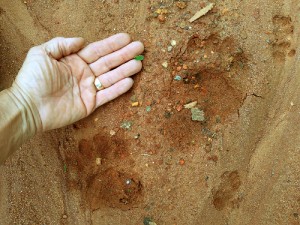
When we find ourselves in a quite moment, it’s amazing to observe what detail surrounds us. Our senses are on alert to report their findings. I enjoy playing the game of observation. I tend to lean most heavily on vision, and I’ll look around… like in cinema, where most scenes start with an establishing shot, then progress to consecutively tighter shots until you reach an extreme close-up. Important information such as wind direction, spacing of tracks, shape of foliage, slope of the landscape, or other such details can mean the difference on whether or not we will be able to drink, eat, or be safe. You can “see” the photograph above showing a patch of clover, but what do you “observe”?

Bookmark and Share

Tags:

Ken on May 16th, 2009

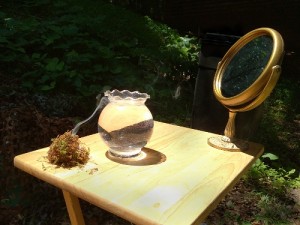
Have you ever tried to make a fire using a magnifier with pine needles as tinder? One of the tricks to successful fires using the solar method is to use tinder that is fibrous, dry and compact, yet loose enough for air flow. Pine needles alone are not dense enough to transfer heat, but if you grab a bunch together, about an inch in diameter, then bind it tight with a green strand of tall grass, and trim the end flush, it works. This allows a surface upon which to focus the light from the lens or reflector. You begin by focusing the light on the sheared surface, and when smoke begins to appear, very slowly begin to spiral outward, increasing the size of the spot to continue the combustion process. When it begins to produced substantial smoke, blow at the center of the smoldering pit to increase it’s size. Usually, a generated a coal is transferred to more tinder, but you will find that just continuing to blow on the bound pine needles will ignite the entire bundle itself.

Bookmark and Share

Tags: , , , ,


UPDATE: Due to a family emergency, I will not be able to teach this class as scheduled, but plans are underway to reschedule the class at a later date which will be posted in a new entry


On Thursday, May 21st, 2009 at 6:00 PM I will be teaching an evening class at the Wilkes County Public Library, NC. The class covers the theory and practice of survival and the critical priorities for surviving. I will cover many of the topics covered at this website, but with the advantage of interaction for further explanation and clarification. The class ends at 7:35 PM so we’ll have time to cover a lot of ground. If you live in the area I would love to see you there.

This event is free and open to the public. For more information, call 336-838-2818 or email afrazier@arlibrary.org.

Bookmark and Share

Tags: , ,

Ken on April 26th, 2009

Recently I discovered a terrific little camp stove called the “TrailStove”. It uses the chimney effect to maximize airflow for combustion of fuel. If you have used a charcoal briquette starter that uses newspaper placed in the bottom chamber of the device to ignite the charcoal briquettes placed inside the upper chamber, you know how this stove works. The TrailStove is a refined version of the charcoal briquette starter, but with smaller dimensions and added features.

It is made of stainless steel measuring 8.75″ inches in height with an upper diameter of 4″ and a lower diameter of 5.15″. It weighs less than a pound at 14.8 oz. A unique feature is the capability of using a blow-tube that can be placed on the lower side for enhanced fire starting. If you’ve ever used a wood burning stove, or worked with a fireplace, you may have used a blow-pipe to put air in just the right place to coax a coal into a flame, or increase the flame for a faster fire. This little addition gives you better control in the fire building process.

The stove can be also used with other fuels such as alcohol burners. But what really impressed me is that this stove is very efficient, and there is virtually no need to carry fuels as there is wood and other cellulose available for fuel in most places that you would hike or camp.

Just use tinder such as dry leaves or pine needles in the lower chamber and place some additional tinder along with kindling such as small twigs in the upper chamber. Then light the lower chamber through the vent holes in the bottom. If needed, you can use the blow-tube to enhance the fire for quicker ignition of the kindling.

The TrailStove is covered by a life time guarantee, if anything ever goes wrong, it can be returned for repair or replaced for free.

The only possible negative to this type of stove is contending with soot on the bottom of the cooking vessel. I use a large cup for heating my food as shown in the picture above (not included in the kit), and when finished, I cover the bottom of the cup with a paper towel, then invert the cup to cover the top of the stove before placing in the travel sack provided. The freedom to not carry fuel is liberating, enabling the stove to be used indefinitely on the trail.

The TrailStove is a wonderful companion on the trail, but the TrailStove can also be used as a backup stove for natural disaster emergencies. Whether used for cooking food, purifying water or as a contained fire source for heat, the TrailStove is easily stored and easily transported for use outside the home.

Because of my positive experience with this stove, I have chosen to carry this in Survialtek’s Store, as I believe it is a great product to use, and durable for a lifetime. Visit my store to order your own!

Bookmark and Share

Tags: , , , ,

Ken on April 25th, 2009


I want to welcome visitors who have viewed my latest video
Bottle Cap Burner Really Cooks!
. It uses hand sanitizer as the fuel source in a bottle cap as a burner. I’ve used regular alcohol in the past and it easily leaks and spills whereas the gel is easy to use. You can also acquire the gel in travel sizes for easy storage and transport. This type of burner generally is good for heating up coffee or scrambling an egg, but not efficient for a full-blown meal… but hey… a warm snack at on a hike can be nice! See more details on my VIDEO page.
Bookmark and Share

Tags: , , , ,